Scenographies and templates
Digital scenography, design and navigation at the service of the experience.

Digital scenography, design and navigation at the service of the experience.
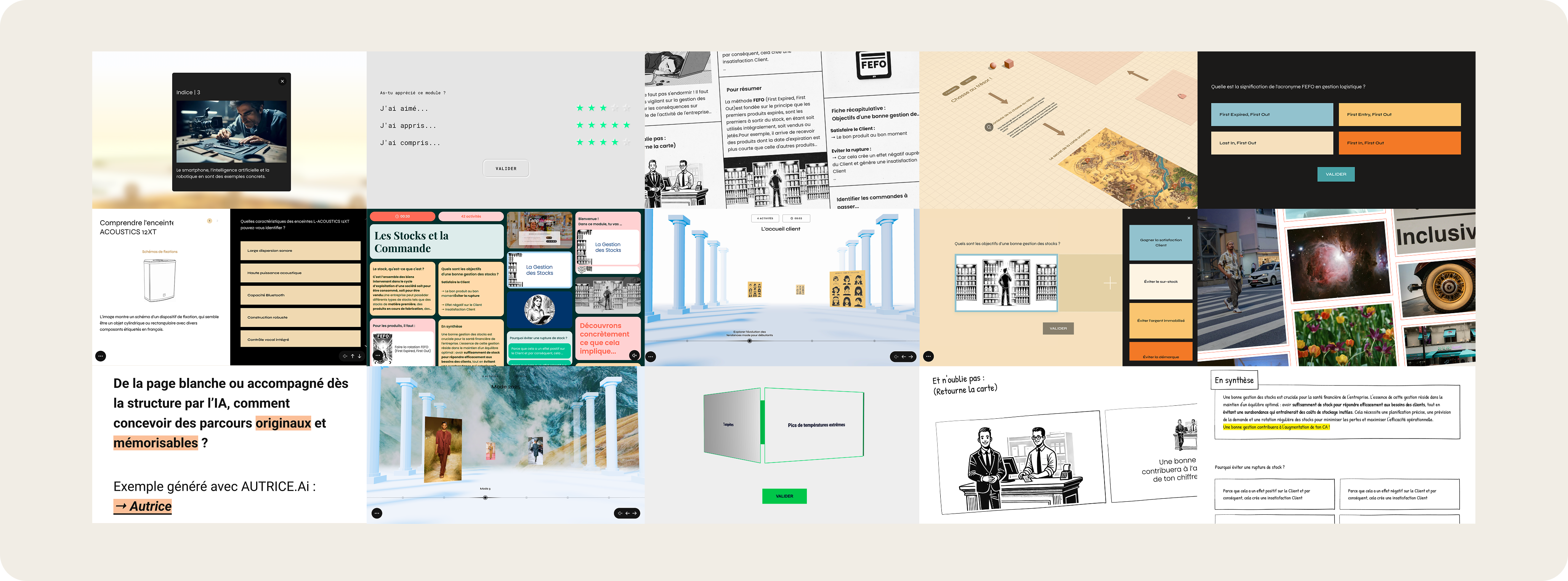
In Autrice, scenography and template are two complementary levers. Scenography refers to the visual architecture and navigation of your digital journeys: how users orient themselves, how they read, how they interact in 2D, 3D, chronologically... The interface design makes learning clear, fluid, and memorable. Template defines how the experience is lived (visual identity, readability, accessibility).
Together, they transform content into an engaging, coherent, and inclusive journey.
Architecture and landmarks
Clear mapping: structured pages, typographic hierarchy, readable blocks.
Breadcrumbs and context menus: you always know where you are and where you're going.
Visible progress: milestones, steps, "you are here".
Smooth navigation
Linear or branching paths (guided/à la carte), seamless return.
Efficient search and filters, tags, suggestions for what to do next ("what to do next?").
Mobile-first and multi-screen (responsive, touch gestures, equivalent keyboard).
Consistent components
Unified UI library (cards, tabs, accordions, modals), clean empty/loading/error states.
Progressive disclosure: show the essentials first, expand the rest as needed.
Ready-to-use page templates to ensure consistency and speed.
Movement and feedback
Useful micro-interactions (confirmations, toasts, visible focus).
Measured motion (respecting prefers-reduced-motion), transitions that guide without distracting.
Loading skeletons for optimal perceived speed.
Accessibility by design
Verified contrasts, adaptive sizes, full keyboard navigation.
Clean semantics (H1→H2→H3 headings), appropriate ARIA, screen reader playback (NVDA/VoiceOver).
Alternative text, descriptive commands, comfortable clickable areas.
Themes and Brands
Brand-specific themes (colors, fonts, iconography) with a common foundation for consistency.
Light/dark mode, highly readable variations, stable spacing rules.
Thoughtful personalization
Contextualized homepage and shortcuts (role, language, level).
Non-intrusive recommendations, "pick up where I left off".
Measurement and Improvement
UX analytics (paths, useful clicks vs. detours, abandonment), privacy-first heatmaps.
A/B testing of templates and patterns, decisions based on actual usage.
In short: Autrice's navigation and design combine clarity, landmarks, consistency, and accessibility so that the user never struggles with the interface; they learn. Mobile/tablet/desktop and ATAWAD.
The mobile app lets you follow your content offline and syncs your progress as soon as you're back online. It also includes activity tracking and personalized alerts.
.png)
.svg)
.svg)
.svg)
.png)