Private and public librairies
On Autrice FLOW, private and public format libraries without limits on entities, categories, according to your charter.

On Autrice FLOW, private and public format libraries without limits on entities, categories, according to your charter.
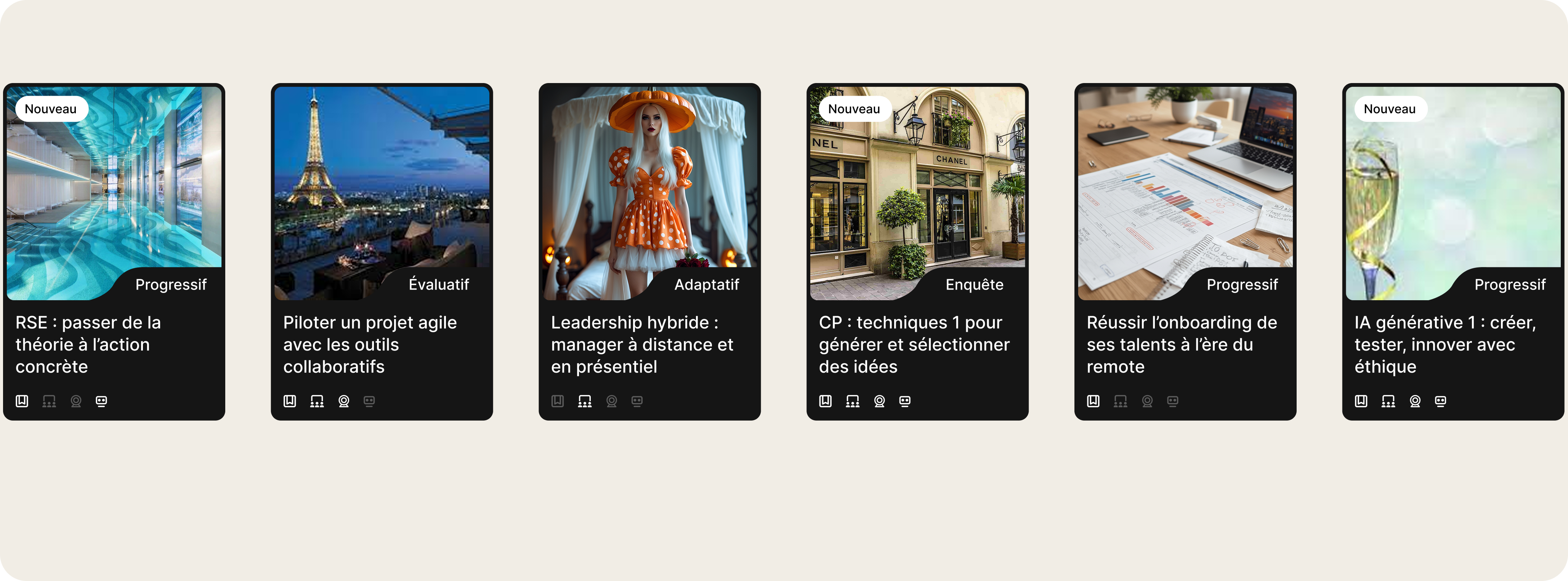
On Autrice, the public library provides access to an open and on-demand reference offering and to the expert authors who design it with or without AI; it is open to all companies upon request.
Private libraries allow you to structure your own models (charter, organization, brands/BU, groups, and entities) with complete control, granular access rights, governance, and traceability.
Private libraries: your educational assets.
Templates branded with your identity (brands, styles, components).
Granular access rights per team/BU/zone, validation workflows, unlimited review.
Custom, semi-custom, and marketplace production.
Localization (languages, time zones), advanced metadata (skills, audiences, compliance).
Complete traceability: who created, modified, and published; version history and justification.
Public library:
Sharing or commercializing expertise to showcase your organization.
Templates validated by Autrice and her community (learning paths, assessments, facilitation kits, simulators, checklists).
A11y-ready (WCAG/RGAA), versioned and adaptable with a single click (tone, duration, level, sector).
AI-assisted: variant generation, contextualization by role/country/language, text-to-speech and transcriptions.
Evidence: examples, rating scales, rubrics, integrated best practices.
Multi-zone syndication and governance:
Inter-zone syndication: a common core, local variants, distribution in the right place at the right time.
Drift alerts: if the core changes, local stakeholders are notified to realign.
Controlled data residency and publication scopes (brand, country, BU).
AI for Reuse:
Multi-format RAG (PPT, PDF, Word, Excel, Keynote, video) to create sourced templates.
Activity generation (informative/evaluative), scenarios, images, voice; self-remediation and level-based variations.
Integrated quality controls (clarity, consistency between objectives and assessments, year-on-year, bias).
Search and Discovery:
Semantic search (themes, skills, objectives), filters by brand/zone/language.
Talking thumbnails (duration, level, format), preview, and instant duplication.
Usage and Impact Measurement:
Analytics: template adoption rates, reuses, time saved, impact on completion/satisfaction.
Rankings and recommendations: highlight what works to accelerate teams.
In short: public libraries propel you forward, private libraries structure you. Together, they offer faster creation, consistent quality, guaranteed accessibility, and controlled distribution, across your brands, countries, and teams.
The mobile app lets you follow your content offline and syncs your progress as soon as you're back online. It also includes activity tracking and personalized alerts.
.png)
.svg)
.svg)
.svg)
.png)